Department of Electrical Engineering
Finite State Machine implemented as a Mealy Machine:
a non-resetting sequence recognizer.
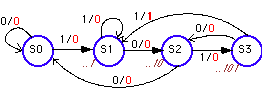
The following state diagram (Fig. 1) describes a finite state machine with one input X and one output Z. The FSM asserts its output Z when it recognizes the following input bit sequence: "1011". The machine will keep checking for the proper bit sequence and does not reset to the initial state after it has recognized the string. As an example the input string X= "..1011011..." will cause the output to go high twice: Z = "..0001001.." . When the machine is in the state S3 the output will go high after the arrival of a "1" at the input. Thus the output is associated with the transitions as indicated on the state diagram.
Figure 1: State diagram, describing the sequence detector implemented
as a Mealy machine. The number in italics underneath the states indicate
which part of the sequence the state remembers.
This state diagram can be described in ABEL code given in Listing 1.
The output is described with the "With"
keyword to indicate that the output will change when the input goes to
one.
Listing 1: ABEL source code for the Mealy Machine
implementation of the sequence detector described in Fig. 1
module Seqdet1
Title 'Sequence
Detector 1011 with Mealy Machine'
Declarations
"Input and output signals
X, CLOCK, RST
PIN;
Z PIN istype 'com';
Q1, Q0 PIN istype 'reg';
"State
register definitions
" and assignments of state
values
SREG = [Q1,Q0];
S0 = [0,0];
S1 = [0,1];
S2 = [1,0];
S3 = [1,1];
Equations
"Define the clock signal for the state machine
[Q1,Q0].AR
= RST;
[Q1,Q0].CLK =CLOCK;
"Define state diagram
STATE_DIAGRAM SREG
STATE S0: IF
X THEN S1 ELSE S0;
STATE S1: IF X THEN S1 ELSE
S2;
STATE S2: IF X THEN S3 ELSE
S0;
STATE S3: IF X THEN S1 WITH
Z=1; ELSE S2;
end Seqdet1
The ouput is specified with the "With" keyword. The corresponding simulation is shown in Figure 2.
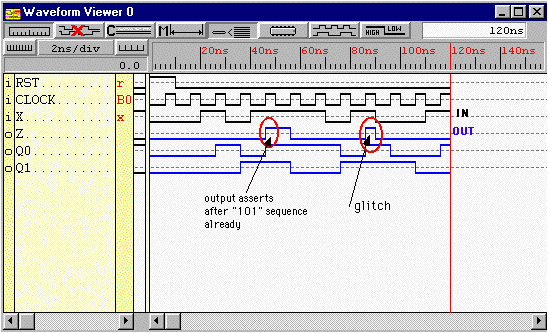
Figure 2: Simulation of the sequence detector for "1011"
described with the state diagram of Fig. 1. (Screen clip from Xilinx XACTstep(TM)
Foundation software)
Notice that the output Z asserts as soon as the input is "1" when in state S3. Comparing this output with the one obtained for a Moore machine of the same sequence detector may let a casual observer think that there is a timing problem as the output seems to asserts already after the "101" input sequence. However, when one looks at the output carefully one concludes that the waveform is correct. One has to realize that the outputs are valid at the end of the state time (just before the positive clock-edge) while the valid inputs are sampled just before the positive clock edge as indicated in Figure 3 below. The input sequence "1011" gives indeed an output sequence of "0001".
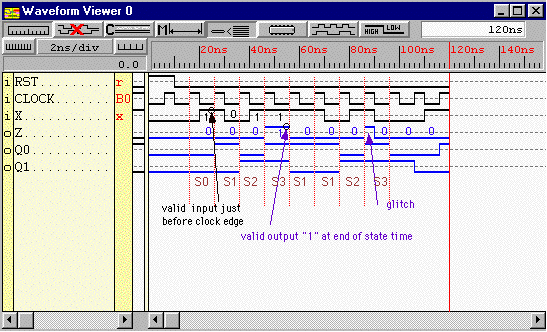
Figure 3: Output waveform of the Mealy machine (sequence detector for "1011") with valid inputs and outputs indicated. (Screen clip from Xilinx XACTstep(TM) Foundation software)
One notices that there is a glitch in the output after the input sequence 10111010. However this occurs at a moment that the output is not valid (the output is valid just before the positive clock edge). The valid output sequence is than 000100000 as expected.
This example indicates that one has to be very careful with the timing
when using a Mealy machine. Outputs can show glitches and are only valid
at the end of a state time (i.e. just before the the positive clock edge
for a positive edge triggered flip-flop or just before the negative clock
transition for a negative egde triggered flip-flop). On the other hand
a Mealy machine can often be implemented with fewer states that a Moore
machine as can be seen from the Moore example.
An alternative way to prevent glitches and to make the ouput of a Mealy
machine synchronous with the clock, it to use a synchronous Mealy machine.
The implementation of the sequence detector as a synchronous Mealy machine
is given in the next example.