Department of Electrical Engineering
Finite State Machine implemented as a Moore Machine:
a non-resetting sequence recognizer.
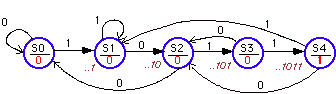
The following state diagram (Fig. 1) describes a finite state machine
with one input X and one output Z. The FSM asserts its output Z when it
recognizes the following input bit sequence: "1011". The machine
will keep checking for the proper bit sequence and does not reset to the
initial state after it has recognized the string. As an example the input
string X= "..1011011..." will cause the output to go high twice:
Z = "..0001001.." . The output will asserts only when it is in
state S4 (after having seen the sequence 1011). The FSM is thus a Moore
machine.
Figure 1: State diagram, describing the sequence detector implemented
as a Moore machine. The number in italics underneath the states indicate
which part of the sequence the state remembers.
This state diagram can be described in ABEL code given in Listing 1.
The output is described after the STATE Si: statement.
Listing 1: ABEL source code for the Moore machine
implementation of the sequence detector described in Fig. 1
module Seqdet2
Title 'Sequence detector implemented
as Moore machine'
Declarations
"input and output signals
X, CLOCK, RST
PIN;
Z PIN istype 'com';
Q2, Q1, Q0 PIN istype 'reg';
"State register declarations
SREG = [Q2,Q1,Q0];
S0 = [0,0,0];
S1 = [0,0,1];
S2 = [0,1,0];
S3 = [0,1,1];
S4 = [1,0,0];
Equations
"Definition of the state machine clock signal
[Q2,Q1,Q0].AR
= RST;
[Q2,Q1,Q0].CLK = CLOCK;
"Define
state diagram
STATE_DIAGRAM SREG
STATE S0: Z=0;
IF X THEN S1 ELSE
S0;
STATE S1: Z=0;
IF X THEN S1 ELSE S2;
STATE S2: Z=0;
IF X THEN S3 ELSE S0;
STATE S3: Z=0;
IF X THEN S4 ELSE S2;
STATE S4: Z=1;
IF X THEN S1 ELSE S2;
end Seqdet2
The corresponding simulation is shown in Figure 2.
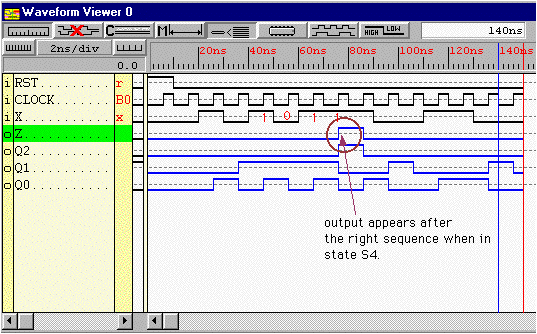
Figure 2: Simulation of the sequence detector (for "1011")
described with the state diagram of Fig. 1. (Screen clip from Xilinx XACTstep(TM)
Foundation software)
One notices that the output asserts after the input sequence 1011 as
specified.